
Mandya district · Temple town guide
Melukote Travel Guide: Temples, Timings, Steps and Day Plan (2026)
MYBy Mohammed Yaseen · Updated November 2026
Two hilltop temples, a stepped tank, an unfinished royal gateway and the best puliyogare in Karnataka, all inside a town you can walk in a morning. Here is how to time Melukote around its temple hours, which steps to climb and when, and what to pair it with.
Melukote in brief: is it worth the trip?
Quick answer
Yes, if you like temples, old stone towns or a quiet half-day out of Mysuru. Reach Melukote by 8 am, see the Cheluvanarayana Swamy Temple first, walk past the Kalyani and the Raya Gopura, then climb Yoga Narasimha hill before the sun gets high, and be out before both temples close for the afternoon.
Melukote, also written Melkote and known in temple texts as Tirunarayanapuram, sits on the Yadugiri hills in Pandavapura taluk of Mandya district, at about 1,090 m (3,589 ft). It is the only settlement in the district above 1,000 m, which is why the air feels cooler than on the plains you drove across. The town is small, with a population of a little over 3,300 at the 2011 census, and almost everything worth seeing is inside a 2 km walk.
Its fame comes from the Sri Vaishnava saint Ramanujacharya, who lived here for about 14 years in the 12th century, and from the Vairamudi festival, when a diamond crown kept in the Mandya treasury is brought up the hill under police escort. Outside festival days Melukote is calm, and that calm is the reason to come. From Bengaluru it works as a long day trip; from Mysuru it is an easy morning.
Melukote day plan: the order that works
- Cheluvanarayana Swamy TempleOpens at 7:30 am. Short queues before the tour groups arrive; allow 45 minutes.
- Raja Veedhi, Raya Gopura and Akka-Thangi KolaSoft light on the gateway pillars and cool walking between the old tanks.
- The Kalyani tankOn the way to the hill road. Walk the pillared corridors quietly.
- Yoga Narasimha hillDarshan opens at 11 am, so climb at 10:30 and you arrive as the doors open.
- Puliyogare lunch at a messMesses serve lunch from late morning; buy the gojju mix on the way out.
- Academy, Janapada Seva Trust or drive onBoth main temples are shut in the early afternoon. Srirangapatna is 35 km away.
This plan is built around one fact: both temples close in the early afternoon and reopen around 4 pm and 5:30 pm. Arrive at noon and you will see one shrine, rush the other and wait three hours for the evening slot. Arrive by 8 am and the whole town fits into one unhurried morning.
Doing Melukote as a day trip from Bengaluru
Leave Bengaluru by 5:30 am, take the Bengaluru–Mysuru Expressway and turn off for Mandya and Pandavapura; you should reach Melukote by about 8:30 am, which is our estimate for a weekday with light traffic. Follow the plan above and leave at 2 pm. That gives you time for Srirangapatna on the way back, which is 35 km away and open into the evening. The full corridor of stops is covered in our one-day trips from Bangalore guide.
Doing Melukote as a half day from Mysuru
Melukote is 51 km from Mysuru, roughly 75 to 90 minutes by car through Srirangapatna and Pandavapura. Leave at 7 am, follow the plan to lunch and you are back in Mysuru by mid-afternoon. If you have two days in the city, slot Melukote into the second morning of our Mysuru 2-day itinerary in place of the zoo.
If you can only arrive in the afternoon
Reverse it. Reach by 4 pm, walk the Raya Gopura and Kalyani in the late light, see Cheluvanarayana when it reopens at 4 pm, then climb Yoga Narasimha for the 5:30 pm darshan and the view at dusk. Carry a torch for the walk down.
Melkote temple timings and dress code
Cheluvanarayana Swamy Temple
Main temple · entry free · daily
Yoga Narasimha Temple
Hilltop shrine · entry free
5:30 – 8:00 pm
5:00 – 8:00 pm
Hours shift on festival days, especially during the Vairamudi Brahmotsava, when the deity is out in procession and the main temple runs to the festival schedule. On ordinary days the hours above hold.
Cheluvanarayana Swamy Temple hours and sevas
The main Melukote temple closes between 6 and 7 pm, so if you arrive at 6:10 pm, use the time for the Kalyani rather than waiting at the door. Sevas are priced low: an archane or ashtottara costs ₹10, sahasranama ₹50, and abhisheka ₹800 to ₹1,200 per person. Pay at the counter inside and keep the receipt.
Yoga Narasimha temple Melukote hours
The hilltop shrine opens for darshan later than the main temple, at 11 am, because the morning hours go to the daily puja and abhisheka. Do not climb at 8 am expecting to go straight in. Photography is not allowed inside the shrine, though you can carry a camera and shoot the view from outside.
What to wear
- Cover shoulders and knees. A dhoti or trousers for men and a saree, salwar or long skirt for women are the norm.
- Footwear comes off at temple entrances. On hot afternoons the stone burns, so a pair of socks helps.
Tip: On weekends the Yoga Narasimha shrine stays open until 2 pm, which takes the pressure off a late start from Bengaluru.
Places to visit in Melukote, in walking order
WalkUpper town in about 1 hourClimb~300 stepsFeesNone for templesCarryWater, cash, cap
1. Cheluvanarayana Swamy Temple
The main temple of Melukote is dedicated to Cheluvanarayana Swamy, a form of Vishnu also called Tirunarayana. It is run by the Yadugiri Yathiraja Mutt and was patronised by the Vijayanagara kings and later the Wodeyars of Mysuru: Raja Wodeyar I granted it land and Krishnaraja Wodeyar III presented jewels and vessels. The gopura dates to the Vijayanagara period. Inside, look for the shrine to Ramanujacharya, whose stay here made Melukote one of the most important Sri Vaishnava centres in South India. Allow 45 minutes, more if there is a queue.
2. The Kalyani, Melukote’s great temple tank
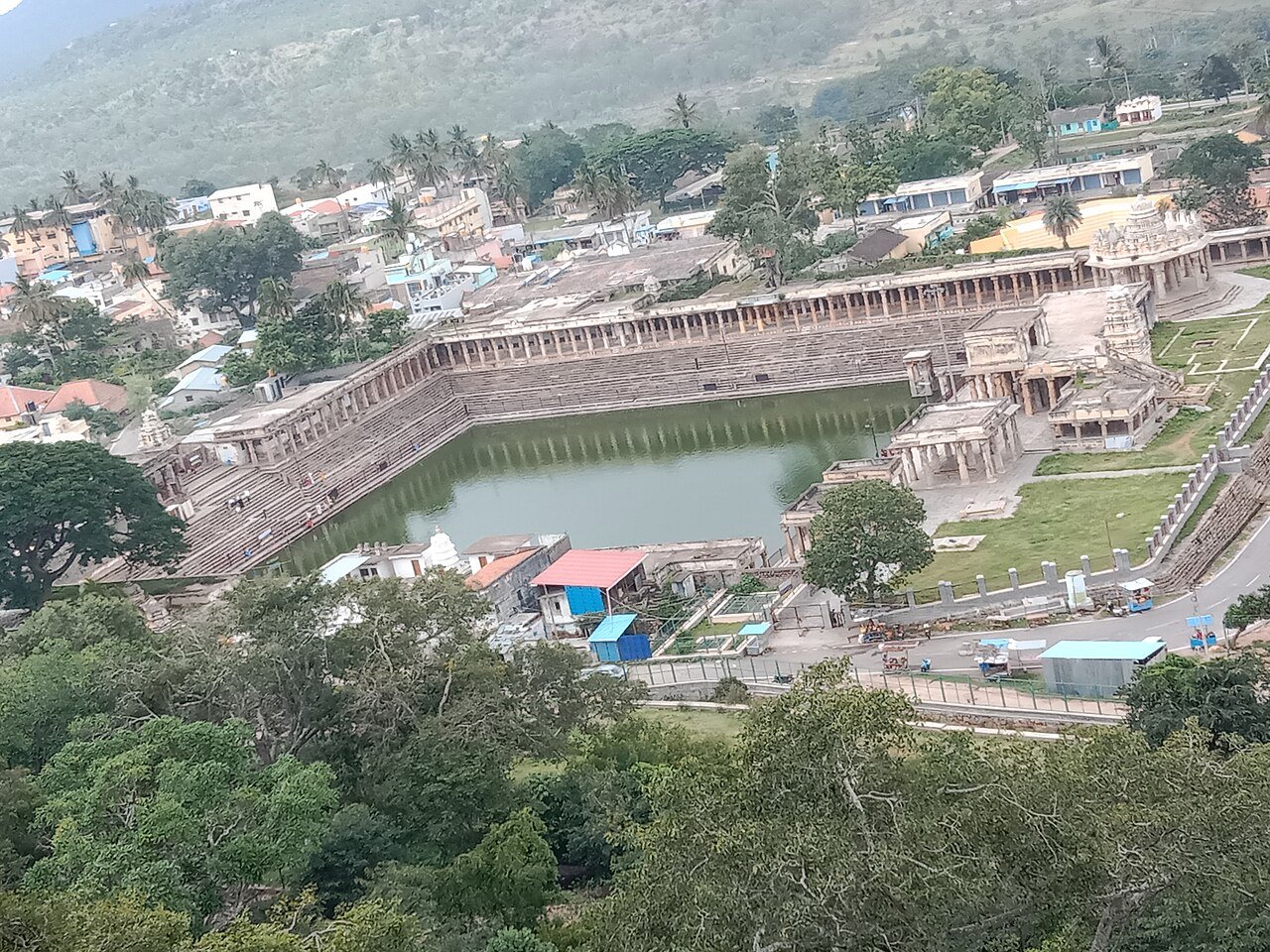
The Kalyani, also called the Pancha Kalyani, is the image most people carry home: a tank more than 200 feet across, with steps on every side and pillared corridors and mantapas around it. The octagonal Bhuvaneshwari mantapa at one edge frames the hilltop temple behind. Pilgrims come here for ritual baths and head tonsuring, so walk the corridors quietly and keep shoes off the steps.
3. Raya Gopura
A short walk from the main temple, four soaring pillars rise from the rock with nothing on top. This is the Raya Gopura, a monumental gateway that was never finished. It was meant as the town’s main entrance and marks the start of Raja Veedhi, the street that runs to the Cheluvanarayana temple. Its builder and the reason it stopped are not recorded with any certainty, which only adds to it. Come early or late: the pillars photograph best against a low sun.
4. Akka-Thangi Kola
Two tanks set side by side, named for an elder and a younger sister who, by local tradition, built them. One was used for drinking water and the other for washing, and a gentle gradient moves water between them. A third tank, Ningannana Kola, sits in the same line. It is a five-minute stop, best combined with the Raya Gopura.
5. Yoga Narasimha temple and the hill steps
The Yoga Narasimha temple crowns the highest rock of Melukote. The deity is Narasimha seated in a yoga posture, and tradition holds that Prahlada installed the image. The temple dates to the Hoysala period; Krishnaraja Wodeyar III gave a gold crown, and a large drum in the temple is said to be a gift from Tipu Sultan. The ambulatory around the sanctum has small windows that look straight down on the town and the Kalyani.
Cars can drive up the hill road to its base. From there it is about 300 steps, cut into granite with handrails most of the way, and a steady climb takes 15 to 25 minutes. There is little shade on the upper half. Senior travellers manage it with rests; anyone with knee or heart trouble should see the main temple and enjoy the hill from the Kalyani instead.
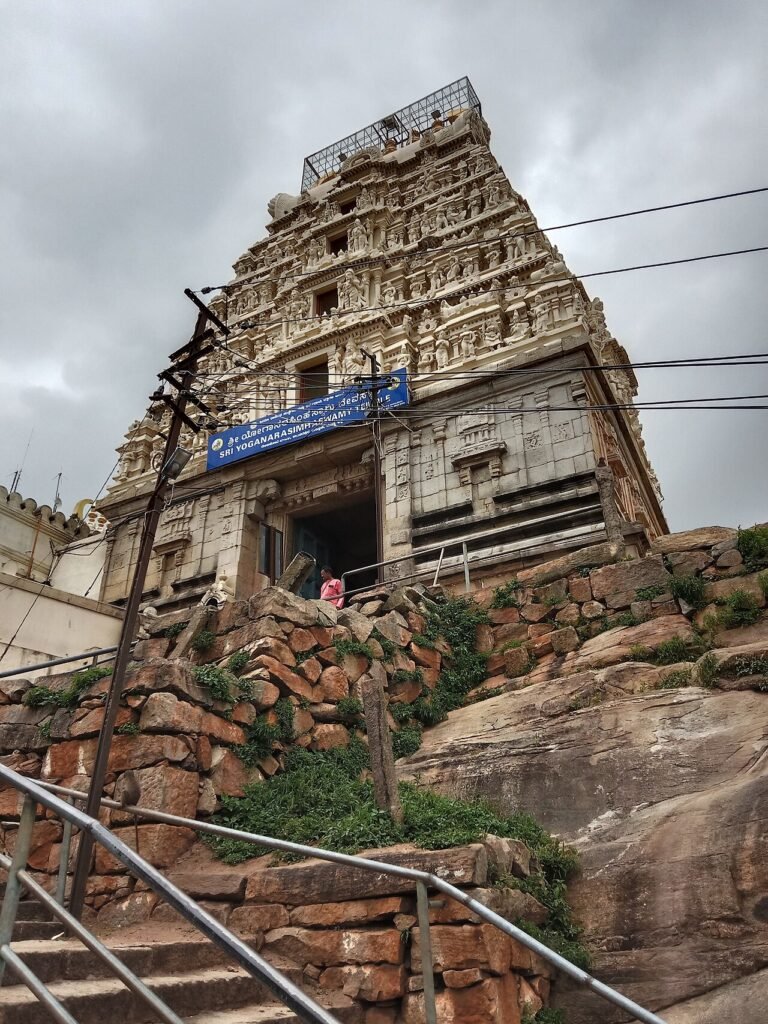
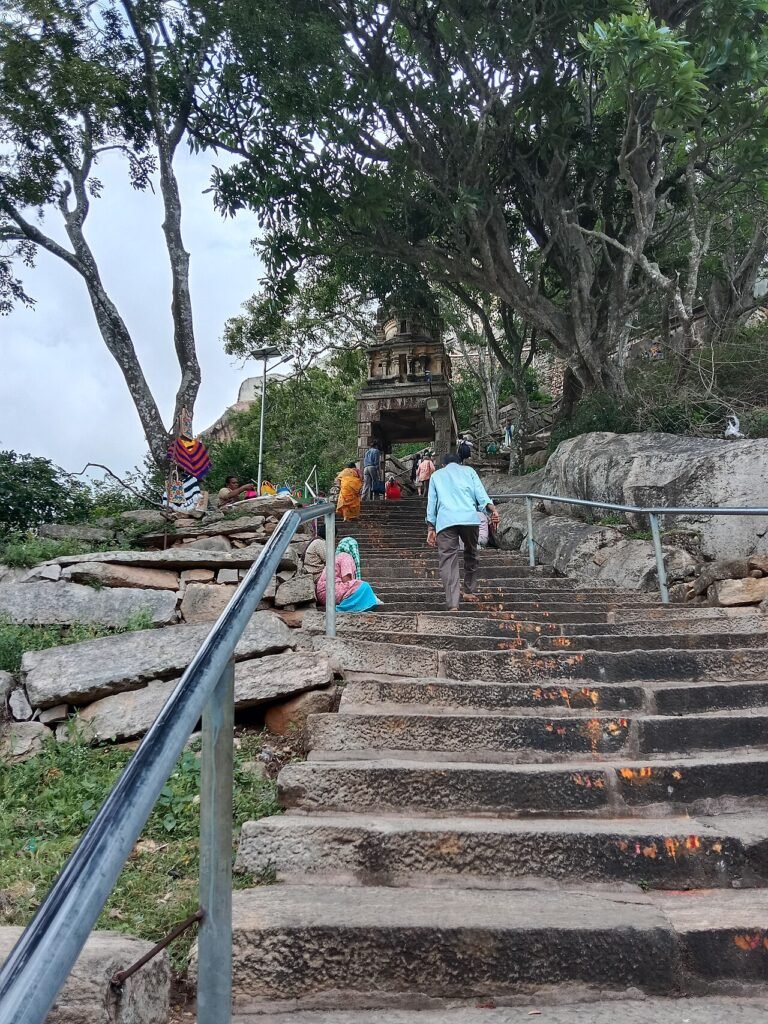
6. Academy of Sanskrit Research
Set up in 1978 on a 14-acre campus at the southern end of town, the academy holds around 11,000 palm-leaf and paper manuscripts and some 35,000 books, which it is preserving and digitising. It is a research institution rather than a museum, so treat a visit as a courtesy call: ask at the office during working hours before walking in. Melukote is also home to the Sri Veda Vedantha Bodhini Sanskrit College, founded in 1854.
7. Janapada Seva Trust
On the edge of town, the Janapada Seva Trust has worked since the 1960s on khadi weaving, organic farming and a Gandhian way of life. It was begun by Surendra Koulagi and is now run by his son, Santhosh Koulagi. If handloom matters to you, it is the most rewarding hour you can spend in Melukote after the temples; call ahead rather than turning up at lunchtime.
8. Dhanushkoti and the Pandava caves
Dhanushkoti is a rock where, by legend, Rama’s arrow opened a spring to quench Sita’s thirst. The road to the Yoga Narasimha temple also passes caves locally called Pandava Gudi, and the district records megalithic burials and line drawings on a boulder as signs of very early settlement on these hills.
9. Melukote Temple Wildlife Sanctuary
The sanctuary around the town was notified on 17 June 1974, mainly to protect the Indian wolf. Leopards, jungle cats, bonnet macaques, langurs and pangolins also live here, and about 200 bird species have been recorded. It is not a safari park: there are no jeep rides to book, so for most visitors it is the rocky scrub country you see on the drive in.
How to reach Melukote from Bangalore and Mysuru
From Bengaluru
133km
Car via the expressway, Mandya and Pandavapura
3–4 h, our estimateFrom Mysuru
51km
Car or KSRTC bus via Srirangapatna and Pandavapura
75–90 min by carKSRTC tour
₹670
Weekend package from Bengaluru with Srirangapatna; ₹500 per child
Full dayFrom Mandya
40km
KSRTC bus or taxi; nearest practical railhead
About 1 hFrom Srirangapatna
35km
Car or taxi; pair the two in one day
About 1 hFrom Nagamangala
29km
Car; useful from Hassan or Shravanabelagola
About 45 minMelukote from Bangalore by car
The quickest route is the tolled Bengaluru–Mysuru Expressway to Mandya, then north-west through Pandavapura and up the hill road. The last stretch climbs gently through scrub and boulders, and the town appears suddenly on the ridge. Tolls, speed limits and exits are in our Bengaluru–Mysuru Expressway guide. If you are coming from the north or west of Bengaluru, the NH75 route through Nagamangala avoids the city’s southern traffic and joins Melukote from the other side.
Melukote by bus
KSRTC runs regular buses to Melukote from Mysuru, Mandya, Pandavapura, KR Pet and Nagamangala. From Bengaluru, the simplest public-transport plan is a bus or train to Mandya and a bus onward. Some services drop you at Jakkanahalli junction, 7 km below the town; buses climb from there roughly every hour, and autorickshaws cover the gap. Inside town, an auto charges around ₹50 to take you up to the hill temple and around ₹150 to wait and bring you back. Timetables, booking and bus classes are explained in our KSRTC bus guide.
Melukote by train
There is no station in Melukote. Mandya, about 40 to 45 km away, is the practical railhead on the Bengaluru–Mysuru line and has frequent trains; see Bangalore to Mysore by train for services that stop there. Take a taxi or bus from Mandya.
Before you go: fuel up and draw cash in Mandya or Pandavapura. Melukote has small shops, but an ATM queue on a festival day can eat an hour.
Melukote puliyogare, where to eat and where to stay
Melukote’s puliyogare is tamarind rice the Mandyam Iyengar way: rice cooked with tamarind, groundnut and spices. It is served as temple prasada in leaf cups at shaded spots on the way down the hill, and it is the one thing everyone takes home.
Where to eat
- Subbanna Mess, Upper MelukoteThe famous oneRunning for close to a century, with a vegetarian lunch and puliyogare. It also sells ready-made puliyogare gojju, bitter lime gojju and pickle to carry home.
- Annapoorna Mess, near Yedhushala bookstallAbout ₹60A simple vegetarian lunch on stitched leaf plates.
- Shree Nidhi Restaurant, near the bus standBack-upA regular South Indian menu if the messes are full.
Meals in the messes are vegetarian and served the traditional way on leaf plates, so come hungry and do not waste food. For more on the region’s cooking, see our Mysuru food guide and food to try in Karnataka.
Where to stay
Melukote has only basic pilgrim lodging, such as Ahobila Yatri Nivas, Bagur Yatri Nivas and Yadhugiri Guest House, with plain rooms in the ₹500 to ₹650 range and shared or simple bathrooms. They suit pilgrims staying for a festival or an early seva. Everyone else should sleep in Mysuru, Srirangapatna or Mandya and drive in; our where to stay in Mysuru guide compares areas and budgets.
Vairamudi Utsava and the best time to visit Melukote
Vairamudi Brahmotsava
The Vairamudi Brahmotsava is the chief festival of the Cheluvanarayana temple, a 13-day celebration each March or early April. On the main night the processional deity wears the Vairamudi, a diamond-studded crown that belonged to the Wodeyars and spends the rest of the year in the government treasury in Mandya. On the morning of the festival it leaves the treasury, receives pujas at the Lakshmi Janardhanaswamy temple in Mandya and travels to Melukote in procession under armed escort.
In 2026 the Brahmotsava ran from 23 March to 4 April, with the Vairamudi day on 28 March and the Teppotsava, the float festival on the Kalyani, on 1 April. More than two lakh people were expected on the main day; the district deployed about 1,210 police, KSRTC ran around 140 extra buses, parking was set up at 14 locations with free mini-bus shuttles, and free meals were served at the Dasoha Bhavan for 24 hours. The 2027 dates follow the temple calendar and are announced by the Mandya district administration a few weeks ahead.
Going for Vairamudi? Take the KSRTC festival bus rather than a car, arrive in daylight, and expect the procession late in the evening. If you want to see the temples properly, come on any other day.
Best time to visit Melukote, season by season
Cool mornings, clear views from the hill and comfortable climbing.
Hot, bright days and hot stone underfoot by late morning. Vairamudi falls in March or April.
Cloud, drizzle and the Kalyani at its fullest. Take care on wet steps.
Weekdays are noticeably quieter than weekends at any time of year. For the wider picture across the state, see our best time to visit Karnataka guide.
What to combine with Melukote
The classic pairing is Melukote in the morning and Srirangapatna in the afternoon, because the temples here shut just as Srirangapatna’s monuments are at their best. Families can swap Srirangapatna for Ranganathittu’s boats. The full list of sights in the district is in our places to visit in Mandya guide, and other temple circuits are in famous temples in Karnataka.
Srirangapatna
On the way back to Bengaluru or Mysuru and open into the evening.
Srirangapatna guide →Near SrirangapatnaRanganathittu
An afternoon boat ride among nesting birds after the temples close.
Bird sanctuary guide →Near KRSBrindavan Gardens
The evening fountain show to end a Mysuru-side day.
Brindavan guide →Thondanur (Tonnur)
Another Ramanujacharya town with old temples and a large lake.
Adichunchanagiri
The pilgrim route north via Nagamangala.
Shravanabelagola
A second hilltop climb if you are heading on to Hassan.
Shravanabelagola guide →Melukote mistakes to avoid, and who should skip it
Common mistakes
- Arriving after 1 pm. Both temples close for the afternoon and you lose three hours waiting.
- Climbing Yoga Narasimha at 8 am. Darshan starts at 11 am; climb around 10:30.
- Climbing at midday in April or May. The granite heats up and the upper steps have little shade.
- Driving in on Vairamudi day. Roads and parking fill hours before the procession.
- Planning a night without booking. Rooms are few and basic, and festival dates sell out.
- Wearing shorts. You will be stopped at the temple door.
Do this instead
- Be at the main temple by 8 am and finish the town by lunch.
- Time the climb for 10:30 am or the 5:30 pm evening darshan.
- Take the KSRTC festival bus if you are going for Vairamudi.
- Sleep in Mysuru or Srirangapatna and drive in early.
- Carry cash, water and a cap for the hill.
- Buy puliyogare gojju to take home; it travels well.
Who will love Melukote
Pilgrims, of course, and anyone interested in Sri Vaishnava history and Ramanujacharya. Photographers come for the Kalyani corridors and the Raya Gopura. Travellers who like slow, walkable heritage towns without crowds will enjoy it on a weekday. Senior travellers can see the main temple and Kalyani on level ground; our Karnataka trip for senior citizens guide has more easy pilgrimage places.
Who should skip it
If you want activities, adventure or a resort stay, Melukote will feel like a long drive for a short walk. Families with young children who are not interested in temples will be happier at Srirangapatna and Ranganathittu.
For the official district profile of Melukote, including its history and heritage sites, see the Mandya district administration page.
Melukote: frequently asked questions
What are the Melkote temple timings?
The Cheluvanarayana Swamy Temple is open 7:30 am to 1 pm, 4 to 6 pm and 7 to 8 pm. The Yoga Narasimha Temple is open for darshan from 11 am to 1 pm and 5:30 to 8 pm on weekdays, and 11 am to 2 pm and 5 to 8 pm on weekends and public holidays. Entry to both is free.
How many steps are there to the Yoga Narasimha temple in Melukote?
About 300 steps from the base of the hill, where cars can park. A steady climb takes 15 to 25 minutes, with handrails most of the way and little shade near the top.
How far is Melukote from Bangalore?
Melukote is 133 km from Bengaluru. By car via the Bengaluru–Mysuru Expressway, Mandya and Pandavapura it takes about 3 to 4 hours, depending on traffic leaving the city.
How far is Melukote from Mysore?
51 km, about 75 to 90 minutes by car through Srirangapatna and Pandavapura. KSRTC buses run from Mysuru as well.
Can Melukote be done as a day trip from Bangalore?
Yes. Leave by 5:30 am, see Melukote between 8:30 am and 2 pm, and stop at Srirangapatna on the way back. KSRTC also runs a weekend package tour from Bengaluru covering Melukote and Srirangapatna for ₹670 per adult.
Is there an entry fee or dress code at Melukote?
There is no entry fee for the temples. Wear clothes that cover shoulders and knees, and leave footwear at the temple entrance. Photography is not allowed inside the Yoga Narasimha shrine.
When is the Vairamudi festival in Melukote?
Every March or early April. In 2026 the Vairamudi day was 28 March, within a Brahmotsava that ran from 23 March to 4 April. The 2027 dates are announced by the Mandya district administration a few weeks ahead.
What is Melukote famous for?
The Cheluvanarayana Swamy and Yoga Narasimha temples, its link with Ramanujacharya, the Vairamudi diamond-crown festival, the Kalyani tank, the unfinished Raya Gopura and its Iyengar-style puliyogare.
Where can I stay in Melukote?
Only basic pilgrim lodges such as Ahobila Yatri Nivas, Bagur Yatri Nivas and Yadhugiri Guest House, with simple rooms around ₹500 to ₹650. Most travellers stay in Mysuru, Srirangapatna or Mandya and drive in.
What is the best time to visit Melukote?
October to February, when mornings are cool and the hill climb is comfortable. Arrive by 8 am on any day so you finish before the temples close in the early afternoon.
Plan the rest of your trip
Srirangapatna
Tipu Sultan’s island town, the natural afternoon after Melukote.
Read the guide →Mandya district
Every sight in the district, from Shivanasamudra to Talakadu.
Places to visit in Mandya →Mysuru in a day
Chamundi Hill, the palace and the zoo, hour by hour.
Mysuru 1-day itinerary →Talakadu
Sand-buried temples on the Kaveri, another quiet temple town.
Talakadu guide →Day trips from Bengaluru
Distances, roads and what to pair in a single day.
One-day trips →Mysuru district
Palaces, hills and gardens around the city.
Places to visit in Mysuru →Temple hours, seva prices and festival arrangements are set by the temple and the district administration and can change on festival days. Updated November 2026.